Read Online The Commentary of Ibn Ezra on Isaiah, Vol. 1: Edited From Mss; And Translated, With Notes, Introductions, and Indexes; Translation of the Commentary (Classic Reprint) - Abraham Meir Ben Ibn Ezra | ePub
Related searches:
(PDF) Abraham Ibn Ezra: The Creative Thought and Biting Wit of a
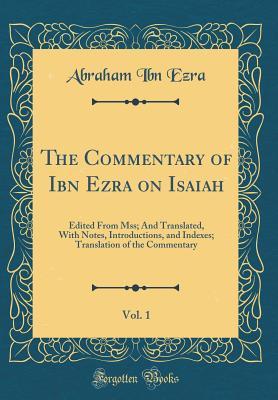
The Commentary of Ibn Ezra on Isaiah, Vol. 1: Edited From Mss; And Translated, With Notes, Introductions, and Indexes; Translation of the Commentary (Classic Reprint)
The commentary of Ibn Ezra on Isaiah / edited from mss. and
Between Secular and Sacred: Abraham ibn Ezra and the Song of
Abraham Ibn Ezra: His Unique Life and the Lessons We Can Learn
White Rose Review: The Unity and Authorship of Isaiah: In
Isaiah 56:9-57:13: Time of the Prophecy and Identity of the
Isaiah in Ancient, Medieval, and Modern Jewish Traditions - Oxford
The Commentary of Ibn Ezra On Isaiah: The Anglican Version of
The Commentary Of Ibn Ezra On Isaiah: Translation Of The
The Commentary of Ibn Ezra on Isaiah (3 vols.) Logos Bible
The commentary of Ibn Ezra on Isaiah : Ibn Ezra, Abraham ben
The Commentary of Ibn Ezra on Isaiah: Translation of the
Книга The Commentary Of Ibn Ezra On Isaiah V1. Translation Of
The Commentary Of Ibn Ezra On Isaiah Translation Of - Unhaggle
Abraham Ibn Ezra on the Book of Isaiah — the University of
The commentary of Ibn Ezra on Isaiah: - CORE
THE SIGNIFICANCE OF CREATION IN THE BOOK OF ISAIAH
Commentary on the book of the Prophet Isaiah; - Calvin University
Abraham ibn Ezra's commentary on the Pentateuch - The British
Rabbi Abraham Ibn Ezra's Commentary on the First Book of Psalms
Rabbi Abraham Ibn Ezra's Commentary to the Torah
The Commentary of Ibn Ezra on Isaiah : book
Isaiah and Deutero-Isaiah - Biblical Criticism Online
Tabeel, The Son of - Jewish Virtual Library
Who is God's Suffering Servant? The Rabbinic Interpretation
The Rabbis' Dilemma: A Look at Isaiah 53 - Jews for Jesus
SPECIAL TOPIC: ISAIAH (Authorship and Unity)
The Gospel According to Isaiah 53
Lucifer in the KJV (King James Version) of Isaiah 14:12
The Holy One of Israel is Savior: Theological Themes in Isaiah
The Philosophers: The Commentaries of Ibn Ezra (Extracts)
Free Online Bible Library Jewish Commentary on the Bible
Who's the Subject of Isaiah 53? You Decide! - Jews for Jesus
Song of Songs: The Emergence of Peshat Interpretation
1516 4171 2005 2697 998 4714 1724 4692 4435 2166 2912
Volume 1 offers ibn ezra’s commentary on isaiah, edited from the original hebrew biblical text, while volume 2 is a translation based on the anglican version of the bible, edited according to ibn ezra’a commentary.
In his commentary to isaiah, ibn ezra interprets the name tabeel to mean no good. Modern scholars are almost unanimous in interpreting tabeel as a syrian-aramean name. It follows the same pattern as the name tabrimmon (i kings 15:18; rimmon is an aramean deity, ii kings 5:18), combining the aramaic adjective ṭāb, good, with a theophoric.
The commentaries of ibn ezra (extracts) i shall inquire into the grammatical form of every word of the torah and explain it to the best of my knowledge. The first verses of genesis should be expressed thus: when in the beginning god decreed the formation of the heaven and the earth, the earth was void and without form.
Rabbi abraham ben meir ibn ezra was born and educated in the golden age of muslim spain. He excelled as a poet, philosopher, grammarian and biblical.
The commentators rashi, ibn ezra, and radak (writing in the eleventh and twelfth centuries) all interpreted isaiah 53 with reference to the nation of israel as a whole, or, more particularly, the righteous within the nation. 14 to a great extent, subsequent jewish interpretation largely followed the interpretations of rashi, ibn ezra, and radak.
The commentary of ibn ezra on isaiah: translation of the commentary, isbn 134645972x, isbn-13 9781346459721, like new used, free shipping in the us no ratings or reviews yet be the first to write a review.
[6] consequently, great classical jewish commentators such as ibn ezra recognized the reference as one to “lucifer. ” [7] finally, the “historical view, since the time of the church fathers, applies the passage to satan.
Abraham ibn ezra's commentary to the torah ('five books of moses' or ' pentateuch').
Rabbi abraham ibn ezra's commentary on the second book of psalms: chapters 42-72 (reference library of jewish intellectual history) (rabbi abraham ibn ezra, poet, philosopher, and mathematic) the commentary of ibn ezra on isaiah v1: translation of the commentary (1873).
Bible commentaries isaiah 66:20 isaiah 66:20 and they shall bring all your brethren for an offering unto the lord out of all nations upon horses, and in chariots, and in litters, and upon mules, and upon swift beasts, to my holy mountain jerusalem, saith the lord, as the children of israel bring an offering in a clean vessel into the house.
Jun 9, 2020 if it recalls the covenant, it can give a covenant tone to the whole book. Isaiah 1 calls israel to account by alluding to the song of moses.
The anglican version of the book of the prophet isaiah ammended according to the commentary of ezra.
In the rabbinical editions of the bible the following commentaries of ibn ezra on biblical books are likewise printed: isaiah (1874;.
Read the text of ibn ezra on isaiah online with commentaries and connections. Ibn ezra’s commentary on the tanakh reflects his knowledge as a hebrew grammarian and philologist. His commentary is terse and aims to discover the pshat, the contextual meaning, of the text. Ibn ezra was known for his independent ideas which aroused much controversy.
“in his commentary on isaiah,” says the encyclopaedia judaica, “[abraham ibn ezra] states that the second half, from chapter 40, was the work of a prophet who lived during the babylonian exile and the early period of the return to zion.
Much to the point is the commentary of the great jewish educator, herz homberg (1749-1841), who says: according to the opinion of rashi and ibn ezra, it relates to israel at the end of their captivity.
A good example is abraham ibn ezra who, in his commentary, made a clear-cut division of the book of isaiah into two parts.
Author of perush ha-torah, the commentary of ibn ezra on isaiah, abraham ibn ezra book of the world, sefer ha-mispar, mozne leshon ha-ḳodesh, a commentary on the book of proverbs, ibn ezra's commentary on the pentateuch, maʻadane melekh.
Abraham ibn ezra’s (1092-1168) commentary on the pentateuch, like rashi’s commentaries, has produced many supercommentaries. He was the first to maintain that isa contains the work of two authors; and his doubts respecting the authenticity of the pentateuch were noticed by spinoza.
Chapters 1 to 5 – isaiah describes the people that live in judah and jerusalem. Chapter some bible students think that those *hebrew words are the name of a place, ben shamen.
It is a very good transition in prophecy (whether it be so in rhetoric or no), and a very common one, to pass from the prediction of the temporal deliverances.
The anglican version of the book of the prophet isaiah amended according to the commentary of ibn ezra.
It was during his self-chosen exile that he wrote his brilliant works. Ibn ezra was a poet, astrologist, scientist, and hebrew grammarian.
David guzik commentary on isaiah1 describes the vision of isaiah concerning judah and jerusalem, and god's promise of a redemption plan.
“in his commentary on isaiah,” says the encyclopaedia judaica, “[abraham ibn ezra] states that the second half, from isa chapter 40, was the work of a prophet who lived during the babylonian exile and the early period of the return to zion. ” during the 18th and 19th centuries, ibn ezra’s views were adopted by a number of scholars.
Ibn ezra wrote about isaiah 1:2: “and he began by calling the witnesses whom moses had summoned to witness against israel ‘that you shall surely perish. ” ibn ezra linked 1:2 with deut 4:26 and 30:18-19, where moses warns that the people will perish if they worship idols in the land.
Rashi held the position that the servant passages of isaiah referred to the collective fate of the nation of israel rather than a personal messiah.
The straightforward rabbinic approach to elucidate isaiah 53 begins by identifying the astonished speakers in isaiah 53:1-9 and the “servant” in isaiah 52:13 and 53:11.
Ibn ezra also mentions, as works he intends to write, the commentaries on isaiah (1:16), proverbs (3:1) and ezra (1:2).
In a sense, ibn ezra was the forerunner of biblical criticism. He held that the second part of the book of isaiah could not have been written by the prophet isaiah, since it speaks of events that occurred well over a hundred years after isaiah’s death and there is no indication that these were prophesies about future events.
Kimchi says that this is the proof of poverty, that, even in the house of the respectable, there is a lack of decent clothing.
Trübner, 1873], 170–71), though this understanding is not beyond dispute. Kapitel 40–66 (atd 19; berlin: evangelische verlags-anstalt, 1968). For a treatment of creation in isaiah preceded by an identification of passages authentic.
The anglican version of the book of the prophet isaiah ammended according to the commentary of ezra. [hebrew text of ibn ezra's commentary on isaiah] with notes and glossary. Essays on the writings of abraham ibn ezra [with hebrew appendix containing unedited fragments of ibn ezra's.
By abraham ben meīr ibn ezra, michael friedländer� the itinerary of rabbi benjamin of tudela. By benjamin, adolf asher, leopold zunz, fürchtegott schemaja lebrecht. Megillat taanit as a source for jewish chronology and history in the hellenistic and roman periods.
Itamar kislev has argued that rashbam’s torah commentary reflects knowledge of ibn ezra’s “short commentary” on the torah, [21] part of which is his commentary on deuteronomy. If so, rashbam may be emphasizing here his belief in the powers of sorcery in order to distance himself from ibn ezra’s philosophical approach.
Our reconstruction of ibn ezra's exegesis will take the following form: we will first for example, in his commentary on genesis 12:6, ibn ezra notes that the that there were two authors of isaiah, using the historical argument.
Rabbi abraham ibn ezra is the most prominent biblical exegete of the medieval spanish school of peshat exegesis, which pursued the plain sense of scripture on the basis of philology and reason. A true polymath, ibn ezra’s writings demonstrate a mastery of hebrew grammar, philosophy, astronomy, and astrology, as they were known in the middle ages.
Ibn ezra anticipates this objection and refutes it by referring to the literal meaning of ימים days, which may of course be applied to a part of a year. Thus the words in the days of uzziah admit the supposition, that isaiah commenced his prophetical career in the last year of the reign of uzziah.
The approaches of ibn ezra and rashbam to the text of the song are very similar, but the structure of their commentaries is different. In practice, ibn ezra devotes more time and effort to the nitty gritty of peshat exegesis than rashbam, though in both cases, the peshat is their major concern.
An annotated scientific edition of the second part of the commentary of rabbi avraham ibn ezra, one of the greatest commentators of all generations, on the book of isaiah. The edition has three sections: the commentary body is based on all existing variants, version exchange mechanism and continuous annotation by the author.
Spinoza concluded that ibn ezra's reference to the truth, and other such references scattered throughout ibn ezra's commentary in reference to seemingly anachronistic verses, as a clear indication that it was not moses who wrote the pentateuch but someone else who lived long after him, and that it was a different book that moses wrote.
Post Your Comments: