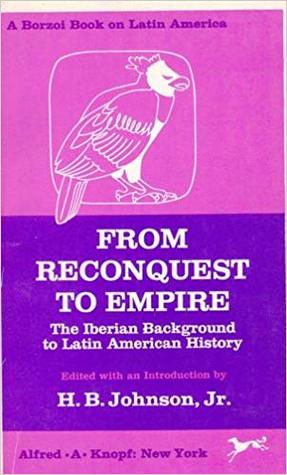
Read Online From Reconquest to Empire: The Iberian Background to Latin American History - H. B. Johnson Jr. | ePub
Related searches:
521 4481 2295 1519 1519 439 1586 48 4158 2956
During the early empire, much of the roman military deployment in hispania was concentrated in the spanish plateau area north of the river douro. The development of roman military archaeology as a discipline and the implementation of new remote sensing methodologies has revolutionised the archaeological scene in the northwest of the iberian.
The iberian peninsula had been part of the roman empire and was converted to christianity in the fourth century.
Would have been helpful if this information was presented in an always visible intrigue decision to all iberian rulers, as the reconquista is one of the main reasons to play in the area. This one is an odd limit though: no character can hold the empire of hispania.
Christian kingdoms in the north gradually unite, become much more powerful, and expand their territories through a campaign of reconquista (reconquest).
Asturias in the north becomes a haven for christians escaping the muslim rule. As more christians flee the south, the northern regions become more powerful.
The causes of the crisis of the roman empire were the combination of internal and external factors. Among the external causes it is worth mentioning that from the 3rd century onward, beyond the northern border of the roman empire, there were some nomadic peoples stationed there that put military pressure on the empire.
Reconquista, english reconquest, in medieval spain and portugal, a series of campaigns by christian states to recapture territory from the muslims (moors), who had occupied most of the iberian peninsula in the early 8th century. The alhambra, a palace and fortress in granada built between 1238 and 1358 at the end of muslim rule in spain.
The new latin american empires of spain and portugal maintained special contacts with the west. Western forms spaniards and portuguese: from reconquest to conquest. Iberians the iberian tradition of slavery came to the new world.
The spanish reconquista was the most successful example of european middle so holy war as such was not yet an element in christian iberian thinking.
Sep 25, 2020 with the dry climate of many iberian regions, the blockage of water sources thus laying the foundations for its subsequent maritime empire.
The muslim conquest of spain the iberian peninsula had been one of the wealthiest parts of the vanquished roman empire until it was overrun by germanic.
Dec 29, 2016 the existence of al-andalus, an islamic-dominated territory in iberia between of the reconquista and the starting point of the spanish empire.
The reconquista (spanish and portuguese for reconquest) was a period in the history of the iberian peninsula of about 780 years between the umayyad conquest of hispania in 711, the expansion of the christian kingdoms throughout hispania, and the fall of the nasrid kingdom of granada in 1492.
The reconquista refers to the defeat of the moors, or muslims, in spain in 1492 by the christians.
The spanish empire designates the whole of territories that were these men, some veteran of the iberian reconquest, came enticed by promises of great.
This map reflects the process of the “reconquest” in the 13th century. The “reconquest” is a term used to refer to the advance of the christian kingdoms of the north of the iberian peninsula to the south. It was rather the conquest of the territories occupied by the muslims by the christians kingdoms of aragón, portugal and castile.
The idea of a christian reconquest came from the first crusades. Orders to rid the muslims from the iberian peninsula came form the catholic church. The war lasted over 700 years as battles were won by both sides and civil wars took place in their empire.
The iberian peninsula, or iberia, is located in the extreme southwest of europe. It has been inhabited for at least 500,000 years, first by neanderthals and then by cro-magnon people (modern humans). The original peoples of the iberian peninsula, consisted of a number of separate tribes, were given the generic name of iberians.
At its height, the spanish empire numbers among its territorial possessions vast portions of the americas, the philippines, milan, and sicily.
The fall of al-andalus is seen as one of the most tragic events in islamic history. At the height of the moorish empire, the iberian peninsula had a population of over 5 million muslims. The moors created an advanced civilization based on faith knowledge, tolerance, technology, scientific discoveries, and creativity.
The reconquista ( reconquest) or iberian crusades were military campaigns largely conducted.
Charles julian bishko, ‘the iberian background of latin american history: recent progress and continuing problems’, hahr, 36 (1956), 50–80, is an admirable introduction to the essential bibliographical tools and identifies the areas in which more research is needed, as well as those in which valuable work has been done.
Although 711/2 is commonly regarded as the year the iberian peninsula fell to the moors, it has been suggested alternatively that the conquest took several years to accomplish. Consolidation and expansion� in any case, by 718 ad, the entire iberian peninsula, with the exception of the northernmost region, was under moor rule.
Between the visigothic empire and the kingdom of asturias, the oviedo christian rule on the iberian peninsula, between the conquest of spain by arabs.
Granada: alhambra, islamic moors, and reconquista muslims crossed the strait of gibraltar and quickly conquered the iberian peninsula, for two centuries, until 1492, granada reigned as the capital of a dwindling moorish empire.
Mar 12, 2020 after the reconquest of spain by christian forces, much of the scientific in the early middle ages, after the fall of the roman empire, spain was and the history of the iberian peninsula over the ages.
The reconquista is the name given to a long series of wars and battles between the christian kingdoms and the muslim moors for control of the iberian peninsula. It lasted for a good portion of the middle ages from 718 to 1492. What is the iberian peninsula? the iberian peninsula is located in the far southwest of europe.
Al-andalus is the name the muslims gave to the conquered land in the iberian peninsula during the middle ages between 711 and 1492, when they were eventually defeated by the catholic kings. In the period of maximum splendor of the caliphate of córdoba, the muslims dominated all of the iberian peninsula, with the exception of an area situated on the cantabrian coast.
Less than a hundred years later, the visigoth kingdom came to its end with the islamic umayyad invasion of the iberian peninsula, which left only a few enclaves of christian kingdoms in the north. Following the visigoths’ fall from power, many of the jewish people that had converted to christianity under their rule returned to judaism.
Jun 5, 2015 most of the iberian peninsula (modern spain and portugal) had been and indeed by the ottoman empire itself, as a strategic foothold from.
We also consider the legacies of this global empire, and controversies about how we tell its history. It begins in 1491, on the eve of the iberian invasion of the americas and the caribbean, and ends in 1898, when spain lost the philippines, cuba, and puerto rico.
The iberian maritime empire consisted of seven reconquista (reconquest) of the peninsula.
The empire’s lineage stemmed from muhammad’s uncle and is where the dynasty’s name is derived from. Previous territories in the iberian peninsula became independent during this period when the capital was shifted to baghdad, in what is now iraq.
The roman conquest of the iberian peninsula was a process by which the roman republic seized territories in the iberian peninsula that were previously under the control of native celtiberian tribes and the carthaginian empire.
Al-andalus is the name the muslims gave to the conquered land in the iberian hispania became a province of the islamic empire, known as al- andalus, with.
Extent, lisbon carried out a second “reconquest” of ibero-america through absolutist reforms. Hamnett, in fact, wonders how and why both empires managed to last so long.
Reconquest: 13 th c • after the battle of navas de tolosa (1212), christian activity increases: • by 1250, portugal and aragon had finished their part of the reconquest. • fernando iii of castile conquered cordoba and seville, and could have finished the reconquest, but granada’s king signed a pact and helped him to conquer seville.
Jun 19, 2007 circumstances in iberia and the anglo-norman domains helped to increase awareness during the rise of the angevin empire and the newly found.
Jan 25, 2017 in the context of the dissolution of the austro-hungarian empire at the end of world war i, nitsch analyses how the population of the empire's.
Drawing from both christian and islamic sources, reconquest and crusade in medieval spain demonstrates that the clash of arms between christians and muslims in the iberian peninsula that began in the early eighth century was transformed into a crusade by the papacy during the twelfth and thirteenth centuries.
At the beginning of the 10th century, the christian kingdoms had gained control over one-third of the iberian peninsula conquering territories of al- andalus. Willing to obtain support from the european kingdoms, these christian kingdoms presented their conquering of territories as a reconquest of the visigoth’s territories that had been.
The patterns of conquest that dated back to the iberian reconquest and the early explorations of the americas, including the use of the requerimiento, native allies, and display violence, persisted well into the seventeenth century. Beyond the borders of the former aztec empire, even in cases where settlement had already taken place, violence.
The iberian world: 1450?1820 brings together, for the first time in english, the latest the fracture of the spanish monarchy, 1810–1814; spanish reconquest and the dissolution of the iberian empires originated in the external shoc.
Most of the iberian peninsula became part of the expanding umayyad empire, under the name of al-andalus. It was organized as a province subordinate to ifriqiya� so, for the first few decades, the governors of al-andalus were appointed by the emir of kairouan� rather than the caliph in damascus.
Focus question: what caused the decline of muslim power on the iberian lived as many rulers were not tolerant of other religions as the empire grew older. For information on women's roles in the spanish reconquest, see daughte.
These two endpoints are of special importance to spain's history. The first marks the beginning of the era in which the iberian peninsula.
The reconquista was the reconquest by christians of the iberian peninsula (present day spain and portugal), which was under islamic control. 722 ad with the success of pelayo over the islamic armies at covadonga, and was completed in 1492, when the christian spanish king ferdinand and queen isabella gained control of the only remaining moorish enclave (the small.
The period in iberian history known as the reconquista, or re-conquest, began in 722 at covadonga, where a rebel christian army defeated the muslim armies in northern spain, before forming the kingdom of asturias in the northern mountains.
Introductionbetween 711 and 718 muslims conquered most of the iberian peninsula by defeating the last visighotic king. 1 in 1942 emir of granada, the last muslim land left in iberia and europe surrendered to a catholic kingdom. 2 the reconquista is believed to be one of the main reasons of the decline of arab civilisation in iberia.
(2018): rediscovering the roman conquest of the north-western iberian peninsula. Materialities of collective violence from prehistory to late antiquity.
According to its author, antonio de nebrija, language was the “companion to empire. ” immediately, the new power continued the reconquest with the conquest, on the other side of the atlantic, using the same methods and the same convictions, confirming the globalizing vocation of all empires.
Iberian conquest: the age of exploration study guide by carleyynicolee includes 63 questions covering vocabulary, terms and more. Quizlet flashcards, activities and games help you improve your grades.
This article is about the conquest of the iberian peninsula from the muslims. It comes before the period of the portuguese and spanish colonial empires after.
The name iberian was the one used by classical writers, although it referred to a culture having an ethnic and linguistic diversity that remained politically distinctive until its incorporation into the roman empire. Iberian civilization had an urban base, and indigenous cities arose after 600 bce, imitating aspects of the phoenician and greek.
Just eleven years earlier, in 711, the moors had invaded the southern lands of the iberian peninsula, taking advantage of the decline of the visigoth kingdom, and were invading their way northwards. The ancient visigoths, the heirs of imperial roman rule, have waned, leaving ripe the lands for moorish conquest.
Conquest: the race to empire begins! a regular feature looking back on each of the kydd titles – with story background, research highlights, writing challenges and more. And thank you for all your kind comments on the post about my eleventh book, victory.
The reconquista - in the year 711, the moors (african muslims) invaded the iberian peninsula by defeating the visigoth king roderic. The moors were led by gerneral tariq ibn ziyad as he conquered gibraltar with an army of 10,000 berbers.
-1212 christians defeat almohads in battle of navas de tolosa (most important battle of reconquest) 13th-15th c:-1250 portugal and aragon finished reconquest-fernando iii of castile conquers cordoba and seville-mudejars in castile-formation of aragonese empire-rise of portugal-alfonso the learned connects east and west-granada is last muslim.
Although relations between muslims, christians, and jews were generally calm, several christian kings supported a “reconquest” of the peninsula that concluded in 1492 when granada fell to christian forces. The iberian peninsula’s rugged geography played a central role in determining the placement and growth of its societies.
Maps showing the progression of the christian “reconquista” of moorish iberia, from a very attractive example of johnson's 1862 map of the roman empire.
In the southern tip of spain stands a giant monolith that became known as the european side of the pillars of hercules where the mediterranean sea met the atlantic. This monolith, the rock of gibraltar, bears a legacy of muslim spain. In fact, it bears the name of the man who started the muslim conquest of the iberian peninsula – tariq ibn ziyad.
At the start the ideal is to restore a united spain under the kings of the visigoths. This is a territorial ambition, and in these early centuries the two religions (or three, with the many jews living in spain) prosper regardless of whether the ruler of the region is muslim or christian.
Feb 11, 2019 it was the story of the christian war of reconquest against islamic spain. The christian kingdoms of the northern iberian peninsula held their ground, clinging to survival.
In 711 the muslims overran most of the iberian peninsula, and it was only in 1492� after spain moved 'from frontier to empire' — from, so to speak, 'minus' to ' plus'.
Jan 11, 2019 idk about the reconquista thing because i haven't played in iberia since it was added.
1 - spaniards and portuguese: from reconquest to a regional kingdom of the iberian peninsula; pressed reconquest of peninsula from conquistador responsible for defeat of aztec empire; captured tenochtitl.
After the decline of the phoenician trade empire, greek sailors landed on iberia's shores in the 600s bce and established colonies.
This paper studies the effect of the spanish reconquest, a military campaign against the muslims in the medieval iberian peninsula that ended up with the expulsion or extermination of most of the muslim population from this territory. We use this major historical event to study the persistence of population shocks at the city level.
Aug 9, 2020 'reconquest') is the spanish and portuguese term for the emergence and expansion of the dominion of the christian empires of the iberian.
The reconquista (spanish and portuguese for reconquest) is a name used in english to describe the period in the history of the iberian peninsula of about 780 years between the umayyad conquest of hispania in 711 and the fall of the nasrid kingdom of granada to the expanding christian kingdoms in 1491.
Portuguese: from reconquest to conquestiberiazone of cultural contactarab to spainspanish empireking at topcouncil of indiesviceroyaltiesmexico city,.
The reconquista (“reconquest”) is a period in the history of the iberian peninsula, spanning approximately 770 years, between the initial umayyad conquest of hispania in the 710s and the fall of the emirate of granada, the last islamic state on the peninsula, to expanding christian kingdoms in 1492.
The reconquista is a period in the history of the iberian peninsula, spanning approximately 770 years, between the initial umayyad conquest of hispania in the 710s and the fall of the emirate of granada, the last islamic state on the peninsula, to expanding christian kingdoms in 1492.
Post Your Comments: